James Hardie New Detached ADU: The San Diego Owner’s Guide
We stock and install James Hardie siding, trim, and weather barrier components for new detached ADUs across San Diego, with most replacement part packages running $1,800 – $4,600 installed depending on what failed and how much of the wall assembly needs to be pulled apart. Most owners discover a problem the same way: a hairline crack opens along a bottom edge near a downspout, or a corner trim board starts holding moisture after two or three winter rain cycles. If you’re reading this because something on your James Hardie-clad ADU isn’t behaving, here’s exactly what we know about what goes wrong, what it costs to fix, and when you actually need to fix it versus when you can wait a season.
Key Takeaways
- James Hardie failures on San Diego ADUs are usually installation-related, not product-related: improper flashing, missing rainscreen gaps, or fasteners placed too close to board edges.
- Most replacement jobs we do in San Diego run between $1,800 and $4,600, and the final number depends on how many boards come off, whether the weather barrier underneath is intact, and whether you have HardiePlank lap siding or HardiePanel vertical sheets.
- You can safely inspect visible cracks, gapping, and fastener pops yourself. Anything involving removal of multiple boards, flashing replacement, or suspect water damage behind the siding should be handled by a crew that does this weekly.
- We carry James Hardie ColorPlus touch-up kits in the most common San Diego ADU shades on our trucks, so small cosmetic fixes often happen same-day without a second trip.
Which James Hardie Models This Applies To
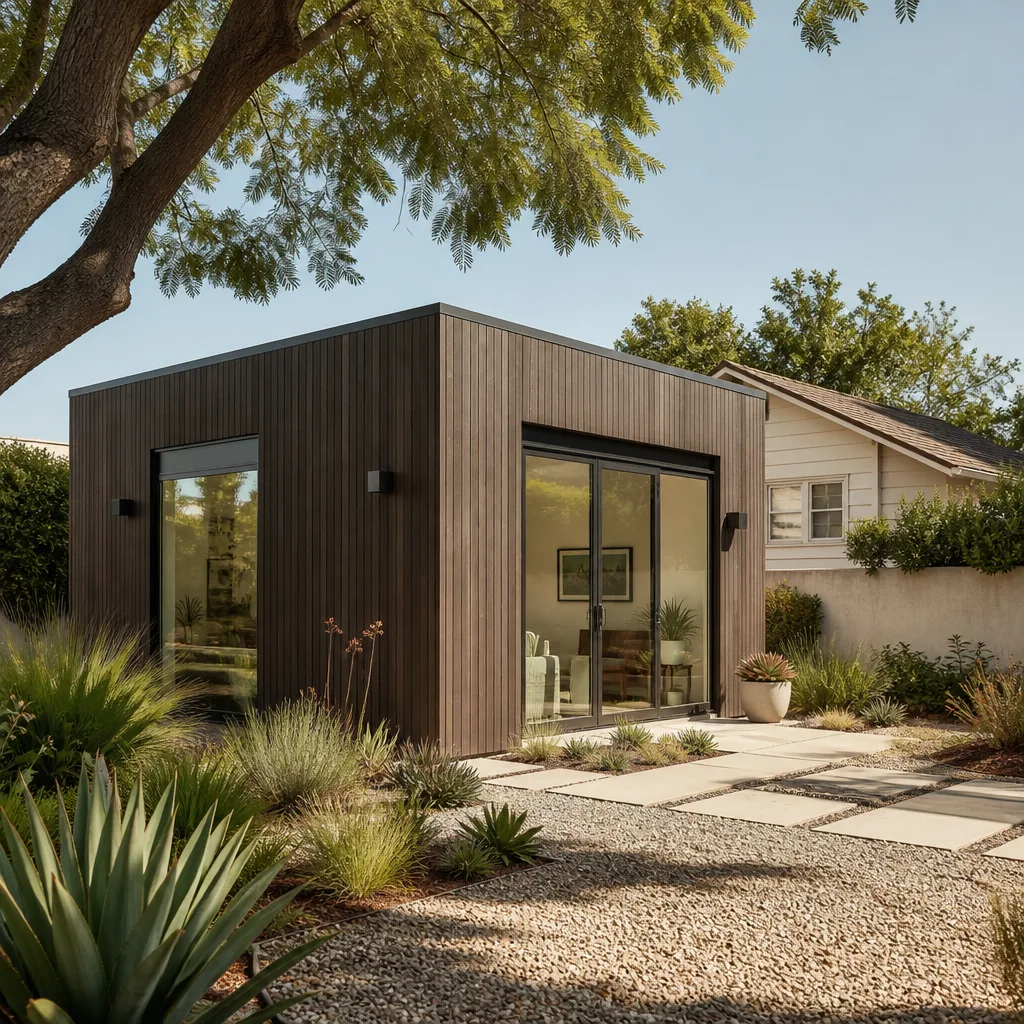
James Hardie makes a few different exterior products, and the part you need depends on which one your ADU was clad with. The two we see most on San Diego detached ADUs are HardiePlank lap siding (the horizontal boards, typically 5/16″ thick, in 6-1/4″ or 8-1/4″ exposures) and HardiePanel vertical siding (4’x8′ or 4’x10′ sheets, usually with a stucco or smooth finish). The trim boards are a separate product line: HardieTrim 4/4 and 5/4 boards, plus HardieSoffit for the eaves. None of these are interchangeable, and a lap siding board will not substitute for a panel sheet even if you cut it down.
The identifying details are usually on the back of an unpainted board or on the manufacturer’s label if the installer left one in the plans. If your ADU was permitted through the City of San Diego, the approved plans will list the exact cladding spec. That matters because James Hardie’s ColorPlus finish carries a 15-year limited warranty on the finish, but only if the product was installed to their published gap and flashing requirements. We’ve walked onto ADU sites in Clairemont and Mira Mesa where boards were installed tight to rooflines with no gap, which voids the finish warranty and causes exactly the peeling and swelling the homeowner called us about.
As for OEM versus aftermarket: James Hardie doesn’t sell “parts” in the mechanical sense, because the product is the part. The decision is really about whether you replace a damaged board with a genuine James Hardie board in the same texture and ColorPlus finish, or whether a generic fiber-cement board gets painted to match. Generic boards are cheaper per linear foot, but the texture profile won’t match existing Hardie boards, and the finish will fade at a different rate. On a new detached ADU in San Diego where the sun hits the south and west walls hard from April through October, that mismatch shows up within two years. We recommend genuine James Hardie replacement boards every time, and we’ll tell you if a non-visible area can get away with an aftermarket panel without anyone noticing.
Signs Your James Hardie New Detached ADU Is Failing
- Hairline cracks at board ends. This is the most common issue we see on ADUs built in the last three to five years. The cause is almost always fasteners placed too close to the board edge, within the last 3/4″, or boards butted tight with no expansion gap. In San Diego’s temperature swings, the boards expand and contract daily, and the stress concentrates at that weak end point.
- Peeling or bubbling paint on the bottom course. If the bottom board sits too close to grade or the roof runoff splashes back onto the wall, moisture wicks into the fiber cement. Hardie boards can handle moisture, but a paint finish can’t handle standing water against the board face indefinitely. We see this a lot on ADUs with short roof overhangs in Kensington and Normal Heights.
- Soft or swollen areas behind the paint. This is the one that worries me. It means water got behind the board and the substrate or sheathing underneath is holding moisture. On a James Hardie ADU, that’s always a flashing problem, a missing weather barrier, or a window opening that wasn’t properly sealed. This one does not fix itself.
- Gapping at corner trim or window trim joints. HardieTrim boards shrink and swell with moisture. If they weren’t back-sealed or the joints weren’t flashed, the corners open up and let water run behind the trim. You’ll see dark staining at the joint, or the caulk will crack repeatedly no matter how many times it’s re-caulked.
- Fastener pops or boards that flex. If you press on a board and feel movement, the fasteners have either pulled through the board or missed the framing entirely. That’s an installation defect, and on a new detached ADU it usually means the crew didn’t hit studs with every fastener. Left alone, the board will rattle in wind and eventually crack.
Replacement Cost & What’s Included
For a James Hardie replacement on a San Diego ADU, here’s what we quote, line by line, before any work starts:
- Single HardiePlank lap board replacement (painted, primed, or ColorPlus): $140 – $260 per board, including removal, disposal, new fasteners, and color-matched touch-up. Most single-board jobs are one board, occasionally two.
- HardiePanel vertical siding replacement (4’x8′ sheet): $320 – $580 per sheet installed, depending on texture and whether we need to cut window or vent openings in the new sheet.
- HardieTrim corner or fascia board replacement: $180 – $340 per piece, including new flashing behind the trim if the old flashing is compromised.
- Bottom-course repair with new Z-flashing installed: $85 – $150 per linear foot, which is the fix we recommend when the bottom board sits too close to grade and shows moisture damage. This includes pulling the bottom course, installing proper flashing, and resetting or replacing boards.
- Full single-wall re-side on a typical 400 – 600 square foot ADU: $8,500 – $15,000, depending on the siding profile, how much trim is involved, and whether the existing weather barrier is still intact.
Every one of those numbers includes the written estimate, the parts, the labor, the job clean-up, and the 365-Day Done Right Promise behind the work. If we open up a wall and find water damage behind the board, we’ll stop, show you photos, and give you a written number for the additional work before we touch anything else. No surprise line items, not on any Seedling job in San Diego.
Can You Repair a Failed Board, or Is Replacement the Only Option?
Small cracks under 2 inches at a board end can sometimes be stabilized with a backer rod and a quality exterior caulk, plus a ColorPlus touch-up kit. That’s a $95 – $160 fix we do in under an hour. But a crack that runs mid-board, any board with visible swelling, or any area where the board feels soft when pressed means the board is compromised. Fiber cement doesn’t heal, and patching it just hides the problem for a season. If water has gotten behind the siding, the board has to come off so we can see what’s happening underneath.
DIY or Call Us?
You can absolutely do the inspection yourself. Walk the perimeter of your ADU after the next rain, look at the bottom courses, press on boards near the ground and around windows, and check every trim joint. If you find a small crack, mark it with tape and watch it for a month. If it’s stable, a caulk and touch-up kit is a reasonable DIY fix.
What you should not do is start pulling boards off the wall. Fiber cement is brittle, and removing one board often means cracking the board above it or tearing the weather barrier behind it if you don’t know where the fasteners are and how the lap is set. And if the failure is at the bottom course near grade, the real problem is the flashing behind it, which is a two-person job to do correctly. We’ve had San Diego homeowners try the bottom-board fix on a Saturday, crack three boards in the process, and call us Monday for a repair that cost more than the original job would have. If you’re standing there with a pry bar and a hope, call us instead. We’ll give you a number before anything moves.
Why San Diego Weather Is Harder on James Hardie Than People Expect
San Diego gets marketed as a mild climate, and for people it is. For exterior cladding, it’s a different story: intense UV on south and west faces from late spring through early fall, salt air within three miles of the coast from Point Loma up through La Jolla, and a winter rain pattern where everything stays damp for days at a time because the overnight marine layer sits right on the walls. Then come the Santa Ana events in October, when humidity drops from 70% to 12% in eight hours and everything expands and contracts at once. Fiber cement handles all of this better than wood, which is why James Hardie is a smart choice for a San Diego ADU. But the installation details matter more here than in places with stable humidity, because the expansion and contraction cycles are constant. That’s why you’ll hear us repeat one thing on every walkthrough: gap, flashing, and fastener placement. Get those three right and the siding will hold for 30 years or more.
FAQs
James Hardie siding itself carries a 30-year limited warranty on the product, and in San Diego’s climate the boards typically hold up for 30 to 40 years if the installation details were done right. The ColorPlus finish has a 15-year limited warranty, though we see fading on south-facing walls in places like North Park and Normal Heights starting around year 10 to 12 depending on tree canopy and sun exposure. The weak point on any fiber-cement ADU is almost never the board itself; it’s the flashing, trim, and bottom-course clearance. If you have concerns about your ADU’s exterior, call (858) 988-6447 and we’ll take a look.
Small end cracks under 2 inches can usually be stabilized with exterior caulk and a ColorPlus touch-up kit, which runs $95 – $160 when we do it. Anything larger, any swelling, any board movement, or any sign of moisture behind the paint requires board replacement. The board is the structural piece, and once it’s compromised, no coating will bring it back. Call (858) 988-6447 with photos and we’ll give you an honest answer about whether you’re looking at a patch or a pull.
A single-board replacement on a San Diego detached ADU usually takes 90 minutes to two hours once we’re on site, including fastening, touch-up, and cleanup. A bottom-course repair with new flashing runs half a day. A full wall re-side takes three to five working days depending on weather, trim work, and whether we’re coordinating around the family’s schedule. Before any of it starts, you get a written price and a clear timeline, so you know the number before the shovel moves. Call (858) 988-6447 to schedule an estimate.
We stock the most common James Hardie ColorPlus touch-up kits, fasteners, flashing profiles, and sealants on our trucks, so many small fixes happen same-day with one visit. Full boards and panels are ordered per job based on your ADU’s exact texture, profile, and finish color, and that usually takes a few days from the local supplier. No guesswork, no substitutions. We’ll confirm the product spec from your original plans or from a physical sample before anything gets ordered. Call (858) 988-6447 and we’ll walk through it together.
We do. Our crews work with ADUs from Abodu, Cover, and Dvele, plus we’re familiar with the cladding and trim packages those companies spec. If your ADU was built by one of those teams and has a James Hardie exterior that’s showing wear, we can address it. We’re an independent San Diego service provider and not affiliated with James Hardie or any of the prefab brands we service.
If you’ve got a James Hardie issue on your detached ADU in San Diego, call (858) 988-6447 and ask for Ben. We’ll schedule a walkthrough, put the number in writing, and leave your property cleaner than we found it.
Written by Ben Ortega, Owner, Seedling ADU San Diego at Seedling ADU San Diego, serving San Diego and nearby areas.