James Hardie ADU Design & Permitting: The San Diego Owner’s Guide
If your James Hardie siding or trim was spec’d into an ADU design and something has gone sideways, whether it’s failed during permitting review or the product itself is underperforming on an existing unit, we stock and install the full James Hardie-compatible line for accessory dwelling units across San Diego. Typical design correction and re-permitting work runs $800 – $2,400 depending on scope, while full siding replacement on an ADU exterior lands between $9,500 and $22,000 installed. Most owners discover the issue one of two ways: the city’s plan checker flags a fire-rating or setback problem tied to the Hardie product spec, or they notice warping, cracking, or water intrusion around Hardie trim boards on a unit that’s only a few years old.
Which James Hardie Models This Applies To
The James Hardie products we see on San Diego ADUs break into two families. HardiePlank lap siding comes in 4″, 5.25″, 6.25″, 7.25″, and 8.25″ exposures, and the exposure size matters more than most people realize: a plan checker in San Diego will hold you to the exact fire-resistive assembly listed in your submittal, so swapping a 6.25″ plank for a 5.25″ isn’t just a cosmetic change, it’s a code change. HardiePanel vertical siding and HardieTrim boards (4/4 and 5/4 thickness) round out most ADU exteriors, and the trim is where we see the most field failures, especially at bottom edges where San Diego’s morning marine layer keeps things damp longer than inland owners expect.
On the OEM versus aftermarket question: James Hardie doesn’t manufacture trim fasteners, flashing, or sealants, but they do publish strict installation specs that dictate which third-party products meet warranty. We use Hardie-recommended flashing tape and corrosion-resistant nails every time, because a failed ADU siding job in San Diego is almost never the plank itself failing. It’s the fastener or the flashing detail behind it. If your ADU has Hardie product that’s cracked, warped, or pulling loose, check the bottom edge and the corner trim first. That’s where water lingers in our coastal air, and that’s where the garage conversion or backyard unit shows its age first.
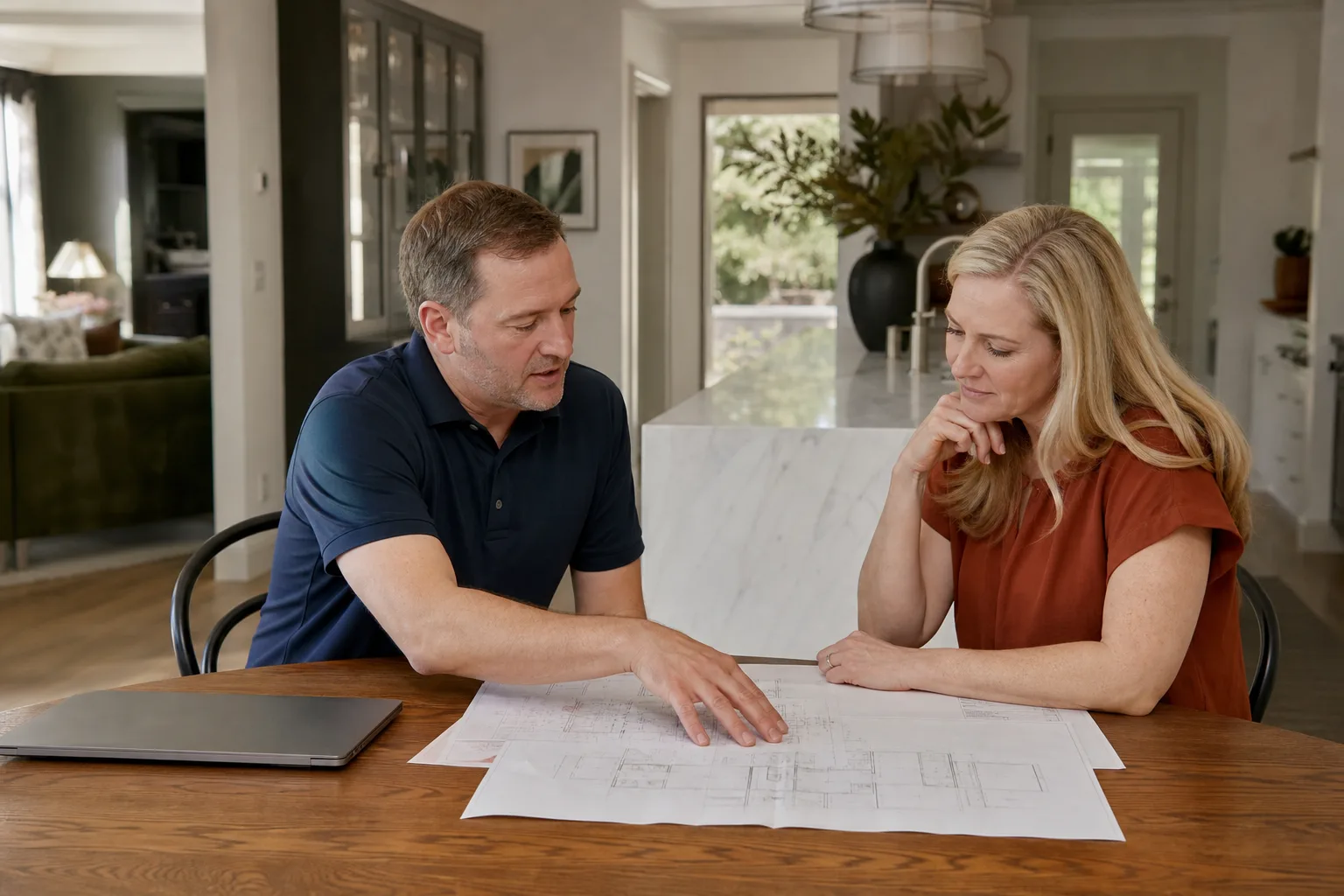
One compatibility gotcha worth knowing: James Hardie products installed within 6 inches of grade on a San Diego lot need a specific clearance and drip cap detail, and a surprising number of ADU plans get this wrong on the first submittal. We fix that drawing before it costs you a second review cycle.
Signs Your James Hardie ADU Design & Permitting Is Failing
- Plan check rejection citing fire-resistive construction. Your ADU sits close to a property line, and the Hardie product you specified doesn’t meet the one-hour wall assembly the San Diego reviewer requires. The fix is usually a denser stud spacing or a different Hardie panel configuration, but it has to be drawn and resubmitted correctly.
- HardieTrim swelling or cracking at bottom edges. This is water wicking up from grade or splashing back from hardscape. Once the trim starts to swell, it’s compromised. Caulk won’t fix it, and paint just buys a season. The board needs to come out, the flashing behind it corrected, and a new piece installed.
- Visible nail heads, called “nail pops,” on plank siding. On an ADU, this usually means the original installer used the wrong fastener or missed the stud. In San Diego’s sun, plank expands and contracts more than people expect, and a shallow nail works itself out within three to five years.
- Gaps opening at plank butt joints. HardiePlank is dimensionally stable, but it’s not zero-movement. If butt joints weren’t properly flashed or the plank wasn’t gapped per Hardie’s spec (1/8 inch nominal), you’ll see gaps open and close seasonally. Those gaps are water entry points.
- Paint peeling in horizontal bands, not isolated spots. That’s trapped moisture behind the plank, not a paint failure. On an ADU it almost always traces back to missing or incorrectly lapped housewrap. The siding has to come off to see it, and the repair is rarely a one-day job.
Replacement Cost & What’s Included
For a typical 400 to 600 square foot San Diego ADU, full James Hardie siding replacement runs $9,500 to $22,000 installed. On the lower end, you’re looking at lap siding over an existing frame with minimal trim replacement. On the higher end, we’re stripping to sheathing, replacing damaged sheathing or housewrap, installing new Hardie trim, and addressing whatever water issues caused the original failure. Design correction and re-permitting alone, without any siding work, typically falls between $800 and $2,400 depending on whether we’re revising drawings, resubmitting to the city, or coordinating with your original designer. Every quote from us is a written, line-item price before any work starts. If we open a wall and find something the original builder hid, we don’t add it to your invoice and keep going. We stop, show you what we found, and give you a new number before we touch anything else. That’s the whole point of the job.
DIY or Call Us?
What you can safely do on your own: inspect the bottom edge of your Hardie trim, check butt joints for gaps, and look for nail heads sitting proud of the plank face. Take photos and measurements. That prepares you to have an informed conversation with whoever you hire. What you shouldn’t do is remove and reinstall Hardie panels yourself. The product is heavy, the cut edges need specific handling, and the fastening schedule is a code requirement, not a suggestion. If you’re up on a ladder working near the roofline of an ADU, the fall risk is real, and even a small mistake in flashing order means water behind the siding within a year. If you’re seeing any of the signs above, call us at (858) 988-6447 and we’ll put eyes on it. Ben Ortega walks every ADU jobsite himself before we quote, because the number on the page only matters if it matches what’s actually happening on your lot.
FAQs
With correct installation and proper clearances, HardiePlank and HardiePanel carry a 30-year limited transferable product warranty, and we routinely see San Diego ADUs where the plank itself is sound at 20 years. The weak points are trim boards and flashing details, which typically fail in years 8 to 15 along the coast and years 10 to 20 inland. If you’re priced out early damage on a young ADU, the culprit is usually installation, not the product. Call (858) 988-6447 and we’ll tell you which one you’re looking at.
Yes, when the damage is limited to a few trim boards or a short run of plank. We can cut and replace sections, match the reveal, and reflash problem areas without a full re-side. The honest caveat is that we won’t know whether it’s a patch job or a teardown until we see what’s behind the failed board. That’s why our written quote includes a contingency scope: you know the worst-case number before we open anything.
For a standard 400 to 600 square foot unit, count on 5 to 8 working days with a crew of two to three. Weather in San Diego rarely stops siding work, but access and existing water damage can add a day or two. We give you a working schedule before we start, and we protect the inside of the existing home with shoe covers and drop cloths any time our crew passes through. You’ll get a photo of the clean-up before we leave each day .
We keep a running inventory of common HardiePlank exposures and HardieTrim profiles at our San Diego yard, and we order project-specific colors and textures direct. That means no week-long wait for a binder when we need a specific plank. For the design and permitting side, we keep San Diego’s most recent ADU checklist and fire-rating tables in-house, so a plan check comment about Hardie product usually gets resolved without a second trip to the city. Mention the brand name when you call, and we’ll tell you what’s on the shelf and what needs ordering.
Call (858) 988-6447 to schedule a free estimate for your James Hardie ADU design or siding repair in San Diego.
Written by Ben Ortega, Owner, Seedling ADU San Diego at Seedling ADU San Diego, serving San Diego and nearby areas.